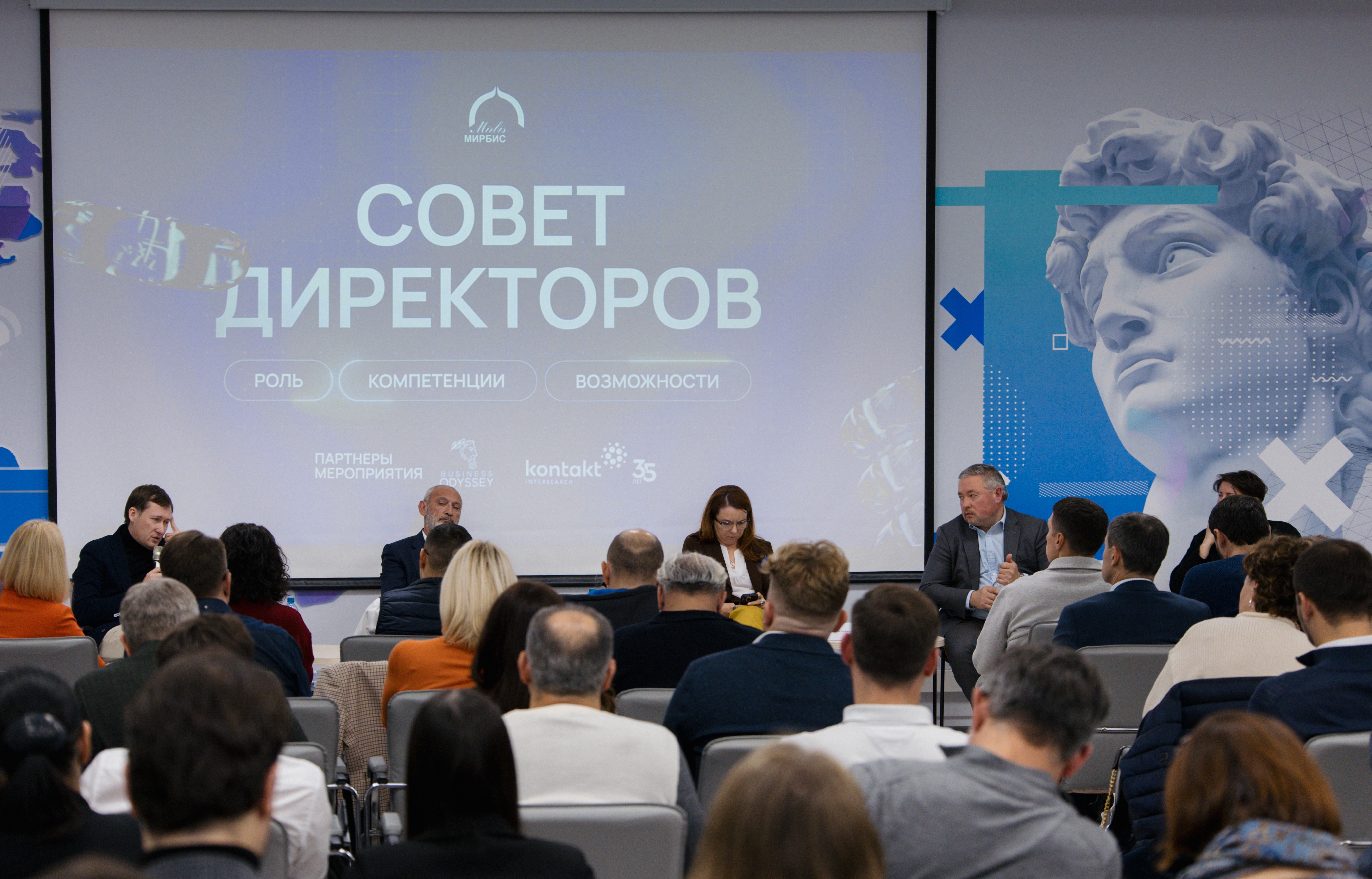
Board of Directors: Role, Competencies, and Opportunities
October 22, Moscow
On October 22, 2025, ink Advisory participated in a panel discussion, "Board of Directors: Role, Competencies, and Opportunities," at MIRBIS Institute. The event was hosted by MIRBIS Institute, Kontakt InterSearch, and the Business Odyssey club. Marina Tarnopolskaya, Managing Partner of Kontakt InterSearch, moderated the panel discussion.
The Board of Directors (BoD) is an important governance body in growing companies. It is responsible for strategic planning, oversight of executive bodies, and safeguarding shareholder interests. Its role is to ensure a balance between strategic goals and operational activities, enhancing investor confidence in business.
Many people are aware that the BoD is a key and essential component of the corporate governance system in large public companies. Kudrat Nurmatov and Ruslan Izmailov, Managing Partners of ink Advisory, also noted the importance of such body for small and medium-sized private companies. Not all private company owners understand that a fully-fledged BoD can serve as an effective sparring partner in decision-making, thereby improving the quality of decisions made by the owner and top management and ensuring business sustainability.
The discussion addressed the following issues related to the BoD:
- From Control to Development
The BoD ceases to be a controlling body and becomes a platform for strategic dialogue. Its key function is not oversight, but rather the alignment of interests of shareholders, management, and stakeholders. Through the BoD, long-term priorities are established, risks and opportunities are assessed, and the company's strategic logic is clarified. This allows owners and managers to act in a coordinated and transparent manner, avoiding duplication of roles and conflicts.
- Board Competencies and the Challenges
A modern BoD requires a different competency structure. In addition to classic financial and legal knowledge, skills in strategic thinking, digital transformation, ESG-oriented management, and risk management are in demand. Mid-sized and large companies are increasingly coming to the conclusion that without a systematic BoD, it is impossible to maintain growth, especially in the face of technological shifts and talent shortages. In this context, the BoD becomes an ecosystem of competencies – a tool that helps owners and top managers make better decisions.
- Balance between Involvement and Independence
A mature board operates on the basis of a constructive balance: it remains an involved partner with management, but does not interfere with operational activities. Its primary role is to set the framework, formulate questions, guide, and support. Effective boards do not replace the executive branch, but rather help it see the bigger picture and test decisions for sustainability and alignment with shareholder goals.
- Collegiality and Decision-Making Culture
Board culture is built on respect for different points of view and the ability to work with disagreement. The key characteristic of a mature board is its ability to engage in collective intelligence: discussion does not weaken, but rather strengthens, decisions. A board is effective when it allows for reasoned debate, but decisions are made collectively and deliberately. This requires not only professionalism but also a high level of personal maturity among its members.
- Structure and Processes
Modern corporate governance practice shows that the effectiveness of a board largely depends on the quality of its organizational architecture. Regular meetings, clearly planned agendas, committee work (strategy, risk, audit, HR), and transparent document flow determine the effectiveness of the entire system. Well-established processes transform the Board from a formality to an active body capable of ensuring management continuity and strategic stability.
- Responsibility and Fiduciary Role
The focus remains on the responsibility of Board members. The Board is not a consultative forum, but a collegial body making decisions with legal and financial consequences. Directors' responsibility is not only collective but also personal. A mature director acts in the interests of the company as a whole, not in the interests of individual shareholders or management. This creates a new culture of responsibility - professional, transparent, and focused on long-term sustainability.
- The Future of the Board of Directors
In the coming years, the role of the Board will only increase. Companies, especially private and rapidly growing ones, will establish the BoD as a mechanism for strategic leadership and institutional continuity. BoD is becoming a marker of management maturity and a factor in investment attractiveness: where it operates meaningfully, a business adapts faster and maintains stability longer.
You can learn more about the issues discussed during the panel discussion on the Kontakt InterSearch blog.
We would like to thank the hosts – Marina Tarnopolskaya at Kontakt InterSearch, and Nikolay Myasnikov at MIRBIS and the Business Odyssey club – for the invitation and excellent organization of the panel discussion.
×
![]()